
Assess concrete quality without destruction
UPV Testing
Ultrasonic Pulse Velocity (UPV) testing measures the speed of ultrasonic pulses through concrete to assess its quality, uniformity, and integrity. The technique is governed by AS 1012.14 and ASTM C597, providing a quantitative, non-destructive measure of concrete condition.
Higher pulse velocities indicate denser, better-quality concrete, while lower velocities suggest the presence of voids, cracks, honeycombing, or deterioration. By mapping UPV readings across a structural element, we identify areas of concern for targeted further investigation.
SiteOps combines UPV with complementary NDT techniques - GPR for rebar mapping, thermography for moisture detection, and rebound hammer testing for surface hardness - to build a comprehensive picture of structural condition without invasive testing.
UPV is particularly valuable for post-fire assessment, where it distinguishes heat-damaged concrete (reduced pulse velocity) from unaffected concrete. Systematic UPV mapping across fire-affected elements defines the boundary between zones requiring remediation and zones suitable for retention.
On site, SiteOps records UPV using direct transmission where both faces of an element are accessible, semi-direct transmission around corners, and indirect (surface) transmission where only one face can be reached. The transmission mode is chosen by element type and access, and the report states which mode was used at each location so the engineer can weight the readings correctly. Path lengths are measured to AS and ASTM tolerances, and transducer coupling is checked on every reading to remove false low velocities caused by poor surface contact.
Velocity results are graded against the recognised quality bands (above 4.5 km/s excellent, 3.5 to 4.5 km/s good, 3.0 to 3.5 km/s medium, below 3.0 km/s doubtful) and presented as a contour map across each element. This turns a set of point readings into a clear picture of where concrete is sound and where further investigation, coring, or repair is warranted. Where strength figures are required, SiteOps pairs UPV mapping with a small number of correlated cores so the velocity map can be calibrated to actual compressive strength for that specific mix.
For Brisbane and Southeast Queensland clients, UPV testing is a fast, low-disruption way to screen large floor plates, bridge piers, marine structures, and precast elements before committing to destructive testing. Because the method is non-destructive and leaves no holes to repair, it suits occupied buildings, heritage fabric, and live infrastructure where access windows are short and downtime is costly.
Key Features
- •Concrete quality and uniformity assessment
- •Internal crack and void detection
- •Compressive strength estimation (with core correlation)
- •Fire damage severity mapping and boundary delineation
- •Honeycombing and segregation detection
- •Long-term deterioration monitoring via repeat surveys
- •Crack depth estimation using indirect transmission
- •Repair bond quality verification
Standards
Applications
- •Post-fire structural assessment
- •Concrete quality verification
- •Heritage masonry assessment
- •Bridge pier investigation
- •Precast element QA
- •Deterioration mapping
- •Repair verification
- •Forensic investigation
Codes & compliance
Australian Standards for UPV Testing
Every upv testing engagement is delivered against recognised Australian and international standards. These are the codes SiteOps works to, and how each one applies to the work.
AS 1012.14
Methods of Testing Concrete - Method for Securing and Testing Cores from Hardened Concrete for Compressive Strength
Australian reference that frames how UPV pulse velocity results are correlated with core strength data for defensible concrete quality assessment.
ASTM C597
Standard Test Method for Pulse Velocity Through Concrete
The primary international method SiteOps follows for transducer coupling, path length measurement, and pulse velocity calculation on every UPV survey.
BS EN 12504-4
Testing Concrete in Structures, Part 4: Determination of Ultrasonic Pulse Velocity
European method used to standardise direct, semi-direct, and indirect transmission readings, including crack depth estimation from indirect transmission.
IS 13311 (Part 1)
Non-Destructive Testing of Concrete - Ultrasonic Pulse Velocity
Provides the velocity quality grading bands SiteOps references when classifying concrete from excellent to doubtful condition.
Stack & equipment
Technologies used

Case experience
Related projects
 Residential
Robina, QLD
Varsity Towers Structural Investigation
Comprehensive investigation of Varsity Towers focused on deflection-critical elements, as-built detailing, and concrete and reinforcement testing to support remediation planning.
View project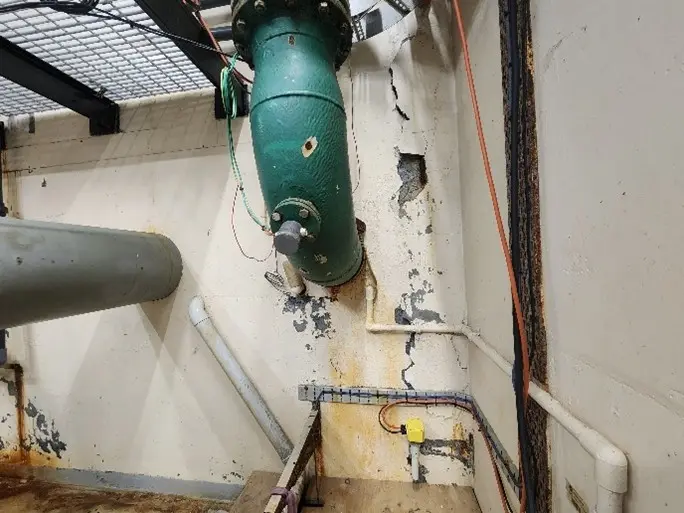 Infrastructure
Main Beach, QLD
GCWA Pumpstation Investigation
Targeted investigation of GCWA Pumpstation concrete wall deterioration, combining as-built detailing with material testing and reinforcement exposure assessment.
View project Residential
Bowen Hills, QLD
Madison Heights Durability Investigation
Durability-focused structural investigation of Madison Heights to quantify carbonation and chloride risk and document reinforcement condition for repair planning.
View projectFAQ
Common questions about UPV Testing
How accurate is UPV for determining concrete strength?+
UPV does not directly measure compressive strength - it measures pulse velocity, which correlates with concrete quality. Strength estimation from UPV alone has an uncertainty of ±20–30%. SiteOps uses UPV as a quality indicator and uniformity mapping tool, always correlating with core test results for definitive strength assessment. The value of UPV is comparative - identifying which zones are weaker relative to other zones.
Can UPV assess fire-damaged concrete?+
Yes. UPV is one of the most effective tools for post-fire assessment. Concrete exposed to temperatures above 300°C shows measurable reduction in pulse velocity due to internal microcracking and dehydration. By mapping UPV across fire-affected elements, SiteOps delineates the boundary between heat-damaged zones and unaffected zones. This mapping guides the extent of demolition and repair.
How long does UPV testing take on site?+
A single UPV measurement takes approximately 30 seconds. For a typical structural element assessment with 20–30 test points, site work takes 1–2 hours. A full-building UPV survey mapping multiple elements typically requires 1–3 days depending on building size and access logistics.
What is the difference between UPV and Schmidt hammer?+
UPV assesses the full cross-section of concrete by sending pulses through it, detecting internal defects and quality variation. Schmidt hammer tests only the surface 30–50mm, measuring hardness as a proxy for quality. SiteOps often uses both - Schmidt hammer for rapid screening of large areas, UPV for detailed assessment at locations identified by screening.
Need UPV Testing?
Tell us about your asset and objectives - we'll scope the right investigation programme.
Get a Quote