
Heritage-Listed Buildings, Adaptive Reuse & Conservation Science
Heritage & Conservation
Heritage buildings require investigation approaches that preserve original fabric while delivering definitive technical data. SiteOps specialises in non-destructive investigation of heritage-listed structures - using GPR, LiDAR, and thermography to understand structures without invasive testing.
We work routinely without original drawings, assessing materials - sandstone, limestone, lime mortar, wrought iron, early steel, pre-standard reinforced concrete - that have never been formally characterised. Our approach starts with the presumption that original fabric is valuable and intervention should be minimal.
SiteOps provides a complete heritage investigation and monitoring solution. Our heritage investigations have enabled targeted retention of original fabric rather than wholesale demolition, delivering evidence-based data that supports conservation-appropriate remediation design.
Typical challenges
- Preserving original building fabric during investigation
- Working without original structural drawings
- Assessing materials no longer in common use
- Heritage authority compliance and approval requirements
- Adaptive reuse structural capacity verification
- Balancing conservation requirements with structural safety
Capabilities
Related services
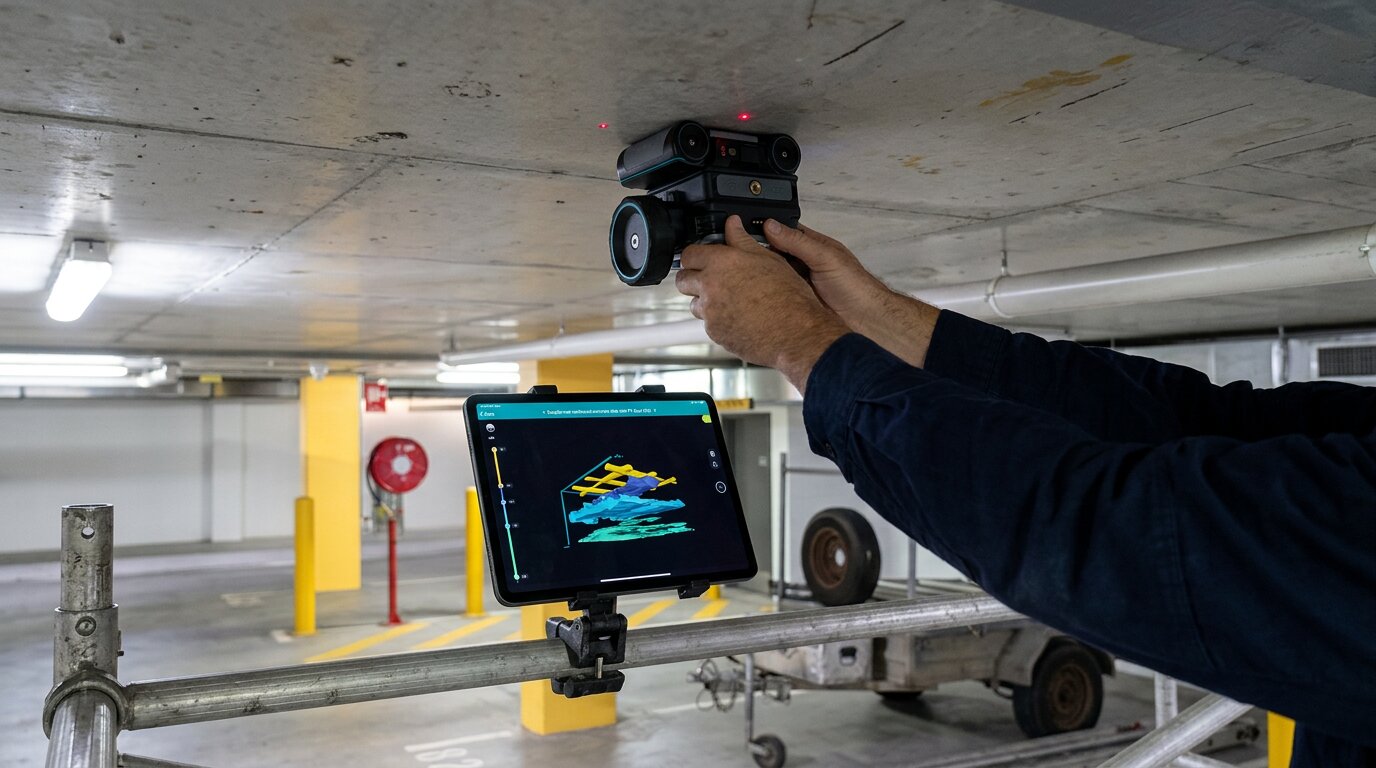
Concrete scanning, rebar mapping, and measured existing-condition documentation
GPR Concrete Scanning, Concrete Radar & Slab Scanning
GPR concrete scanning in Brisbane and Southeast Queensland for non-destructive concrete testing, concrete radar, rebar mapping, post-tension tendon location, slab scanning, conduit detection, void checks, and safe pre-core planning. SiteOps combines ground penetrating radar, Ferroscan, LiDAR, and targeted verification to produce existing-condition layouts for engineers, contractors, and asset owners.
View service →
Assess concrete quality without destruction
UPV Testing
Ultrasonic Pulse Velocity testing is a non-destructive method that measures the speed of ultrasonic pulses through concrete to evaluate its quality, uniformity, and integrity. Ultrasonic Pulse Velocity (UPV) testing for assessing concrete quality, uniformity, and detecting internal defects such as cracks, voids, and honeycombing.
View service →
Access the inaccessible safely
Drone Inspection
Drone inspection (UAV-based structural inspection) uses remotely piloted aircraft equipped with high-resolution optical and thermal cameras to assess facades, roofs, and infrastructure that are difficult or dangerous to access by traditional means. UAV-based visual and thermal inspection for structures, facades, roofs, and infrastructure where traditional access is difficult, dangerous, or cost-prohibitive.
View service →
Laboratory-grade analysis of structural materials
Concrete Coring & Testing
Concrete coring and testing is a destructive sampling method that extracts cylindrical specimens from structural elements for laboratory analysis of compressive strength, carbonation depth, chloride content, and material composition. Concrete core extraction, compressive strength testing, carbonation assessment, chloride profiling, and petrographic analysis through NATA-accredited laboratory partners.
View service →
Preserving the past with present-day technology
Heritage Building Assessment
Heritage building assessment is a specialist non-destructive investigation approach designed to evaluate the structural condition of heritage-listed and historically significant structures while preserving original building fabric. Specialist non-destructive investigation for heritage-listed and historically significant structures, using non-invasive techniques to preserve original building fabric.
View service →Technologies
Technologies used in heritage & conservation
Case studies
Related heritage & conservation projects
Plan an investigation for this sector
Our structural scientists scope NDT to your asset class, access constraints, and reporting requirements.
Get a Quote