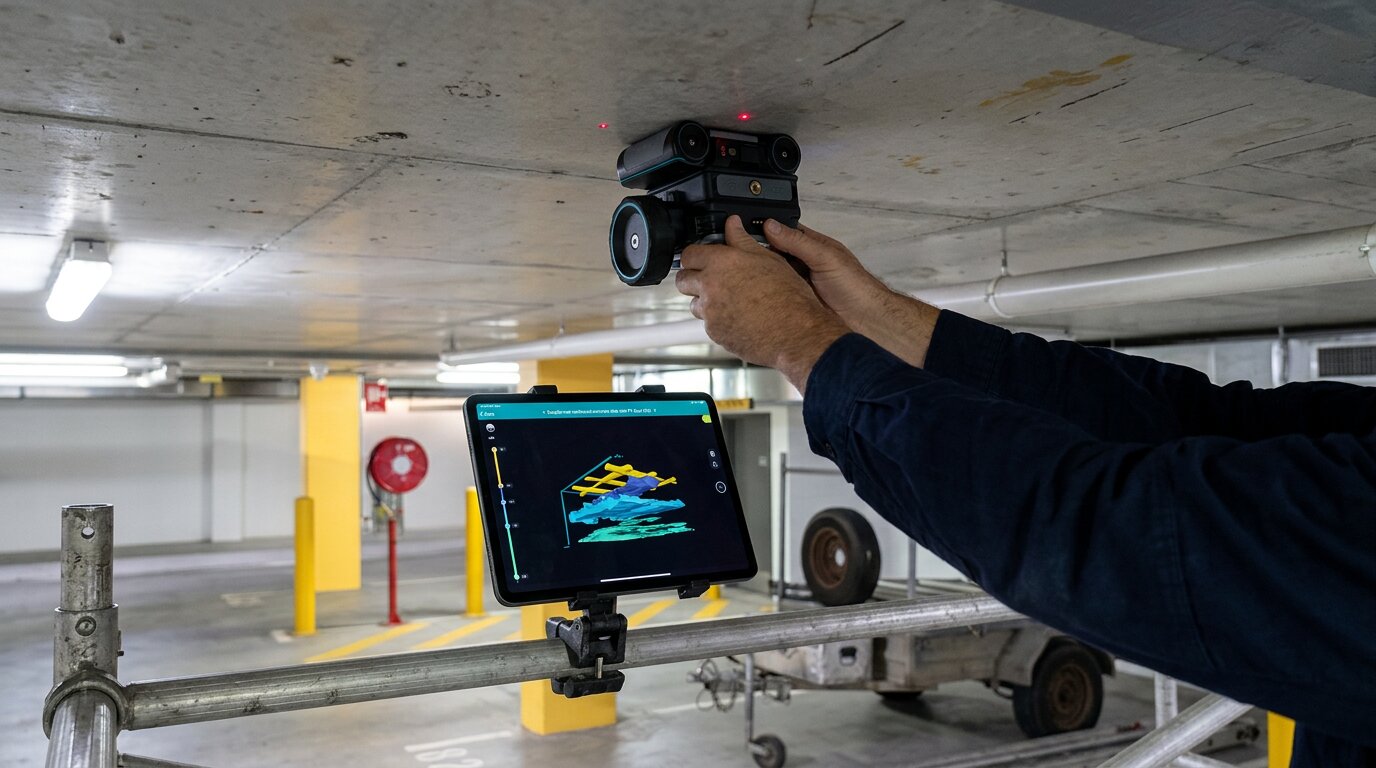
Ground-Penetrating Radar
Sub-Surface Structural Mapping Without Destructive Access
Overview
Ground-penetrating radar is the primary technology SiteOps uses to see inside concrete and masonry structures without cutting, coring, or breaking them open. GPR transmits high-frequency electromagnetic pulses into a structure and records the reflected signals from internal interfaces - reinforcement, voids, conduits, delamination planes, and moisture zones.
For existing asset investigation, GPR is indispensable. When original drawings are missing, incomplete, or unreliable, GPR provides the as-built structural information that every subsequent technical decision depends on. GPR scanning confirms reinforcement layout and cover depths that directly inform chloride penetration analysis and structural capacity assessment.
SiteOps deploys both 2D line-scan and 3D area-scan GPR systems. Higher frequency antennae (1600–2600 MHz) provide fine resolution for reinforcement mapping in the upper 300mm of concrete. Lower frequency antennae (400–900 MHz) penetrate deeper for void detection, slab thickness measurement, and locating post-tensioning tendons.
GPR scanning is non-destructive, non-invasive, and can be performed on occupied structures without disruption. It requires no radiation licensing, produces real-time results on-site, and can cover large areas efficiently.
Applications
Reinforcement Location & Cover Depth
Mapping reinforcement position, spacing, and concrete cover depth across slabs, beams, columns, and walls.
Void & Delamination Detection
Identifying internal voids, honeycombing, and delamination planes within concrete elements.
Post-Tensioning Tendon Location
Locating post-tensioning tendons and ducts before coring or cutting operations.
Conduit & Service Detection
Mapping embedded electrical conduits, plumbing, and other services within concrete.
Slab & Wall Thickness Measurement
Measuring structural element thickness from one side only.
Moisture Ingress Assessment
Identifying moisture migration paths and saturated zones within concrete and masonry.
Technical specifications
| Frequency Range | 400 MHz – 2600 MHz (selectable) |
|---|---|
| Depth Penetration | Up to 600mm in concrete |
| Resolution | 5–10mm rebar detection at typical cover depths |
| Scan Speed | Up to 100 linear metres per hour (2D) |
| Output | Real-time B-scan profiles + 3D depth slices |
| Standards | ASTM D6432, ASTM D4748, AS 2159 |
Related technologies
FAQ
Common questions
What can GPR detect inside concrete?+
GPR detects any interface where material properties change - steel reinforcement, post-tensioning tendons, conduits, voids, delamination planes, moisture zones, and boundaries between different concrete pours.
How deep can GPR scan into concrete?+
High-frequency antennae (1600–2600 MHz) typically penetrate 200–400mm. Lower frequency antennae (400–900 MHz) penetrate up to 600mm or more but with reduced resolution.
Is GPR safe to use in occupied buildings?+
Yes. GPR emits low-power electromagnetic pulses - significantly less energy than a mobile phone. No radiation licensing or exclusion zones required.
Deploy GPR on your asset
Share drawings, exposure conditions, and programme constraints - we will propose an investigation scope aligned to Australian standards and your risk profile.
Get a quote