Technologies
Investigation Technologies
SiteOps integrates more than seventeen non-destructive and selective destructive techniques - from subsurface radar and electrochemical mapping to NATA-certified sampling and computational analysis - so every investigation is matched to the asset, exposure, and technical question at hand.
Capability matrix
Full technology suite
Showing 16 of 16
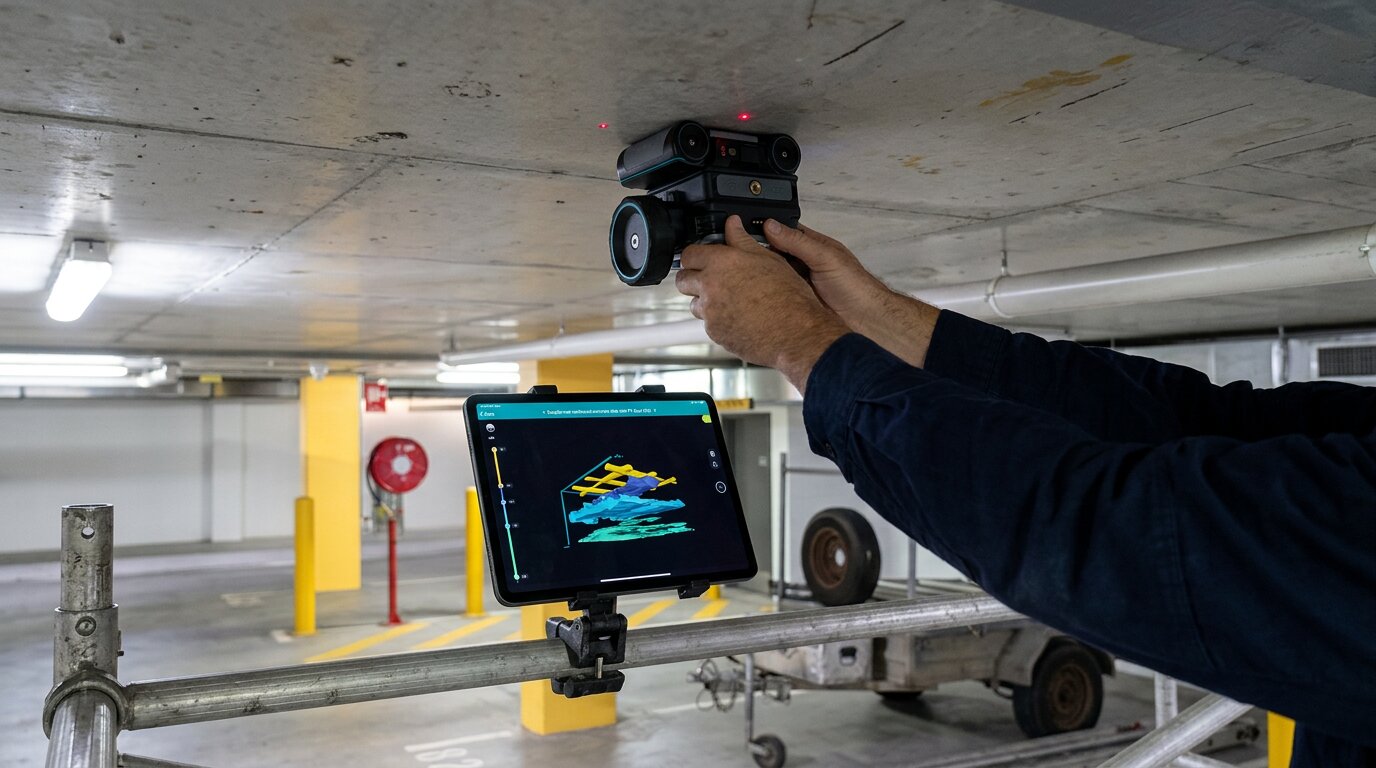 GPR
GPRGround-Penetrating Radar
Sub-Surface Structural Mapping Without Destructive Access
View capability → LiDAR
LiDAR3D Laser Scanning & LiDAR
Point cloud survey, as-built documentation, and deformation analysis
View capability → UPV
UPVUltrasonic Pulse Velocity
In-Situ Concrete Quality and Uniformity Assessment
View capability → UTT
UTTUltrasonic Thickness Testing
Precision Steel Section Measurement for Corrosion Assessment
View capability → Ferroscan
Ferroscan
Electromagnetic Reinforcement Detection and Cover Depth Measurement
View capability → HCP
HCPHalf-Cell Potential Mapping & Half Cell Surveys
Electrochemical Corrosion Probability Assessment
View capability → Schmidt
Schmidt Hammer Testing
In-Situ Surface Hardness and Indicative Strength Assessment
View capability → IE
IEImpact Echo Testing
Slab Delamination and Internal Void Detection
View capability → IRT
IRTInfrared Thermography
Thermal Imaging for Subsurface Defect and Moisture Detection
View capability → Resist.
Concrete Resistivity Mapping
Electrical Resistivity for Corrosion Rate Estimation
View capability → Core
CoreCore Extraction & Laboratory Testing
NATA-Certified Material Characterisation
View capability → Cl⁻
Cl⁻Chloride Profiling & Durability Modelling
Quantifying Corrosion Risk and Remaining Service Life
View capability → UAV
UAVDrone / UAV Inspection
Aerial Visual and Thermal Assessment
View capability → SHM
SHMStructural Monitoring Systems
Real-Time Measurement of Structural Movement
View capability → Pull-Off
Pull-Off / Adhesion Testing
Direct Measurement of Surface Bond Strength
View capability → X-ray
X-rayRadiographic Testing
High-Resolution Internal Imaging
View capability →Science-led deployment
Select the right method - not every method
Technologies are combined under a single investigation plan: calibrated to standards, sequenced to minimise intrusion, and interpreted by structural scientists who understand load paths, durability, and regulatory expectations.