
Commercial buildings and high-rise structures require structural investigation that minimises disruption to tenants and business operations. SiteOps delivers non-destructive assessment programmes designed around occupied building constraints - investigating after hours, using non-contact methods where possible, and staging work to maintain building operations.
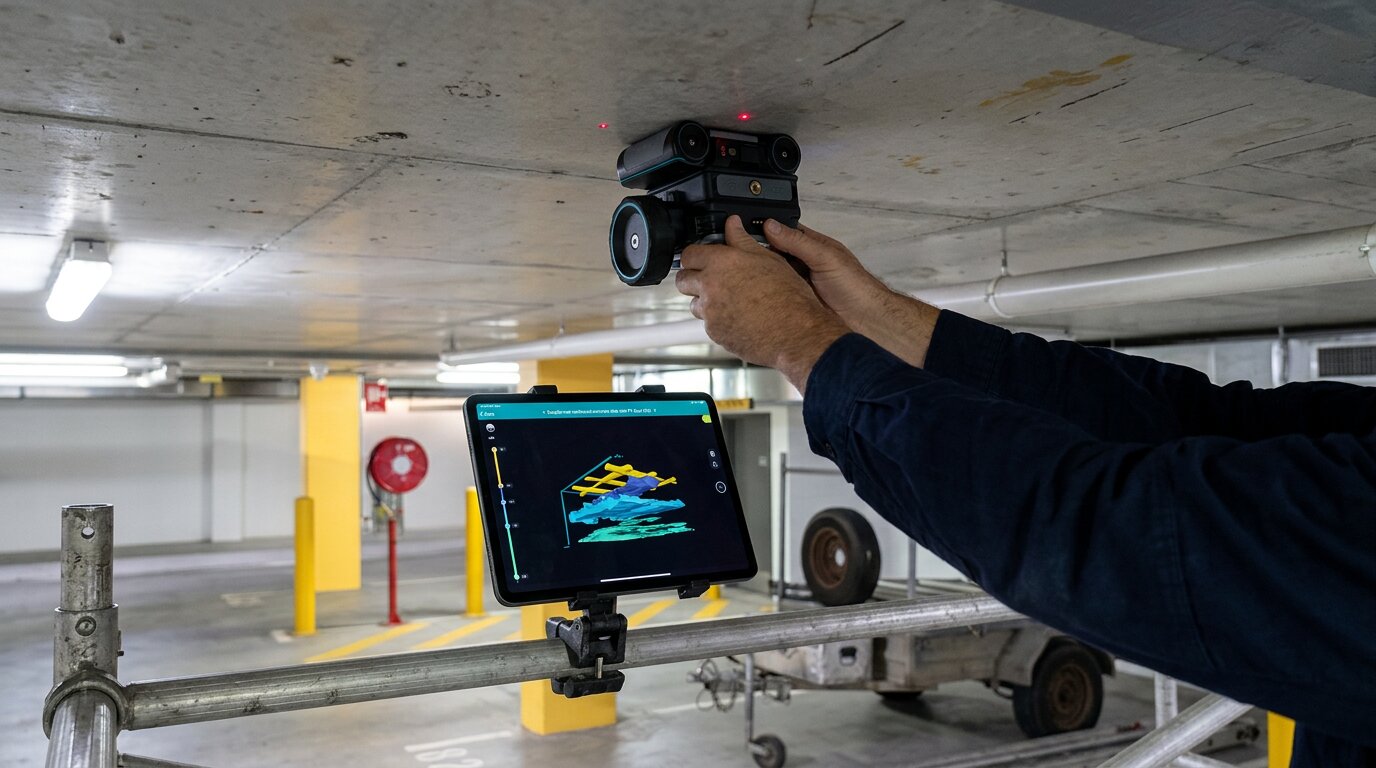
Typical investigations address facade condition, post-tensioned floor systems, car park deterioration, and structural capacity for change of use or tenant fit-out. Our GPR scanning locates reinforcement and post-tensioning without cutting, thermography identifies facade moisture and delamination from ground level, and drone inspection accesses high-rise facades without scaffold.
SiteOps has investigated multi-storey car parks, commercial office towers, and retail centres across Southeast Queensland, providing the evidence-based structural data that asset owners need for capital planning, maintenance budgeting, and regulatory compliance.
Typical challenges
- Minimising tenant disruption during investigation
- Accessing high-rise facades safely and cost-effectively
- Assessing post-tensioned floor systems non-destructively
- Car park deterioration and corrosion assessment
- Change of use structural capacity verification
- Fire damage assessment with rapid re-occupancy requirements
Capabilities
Related services
Concrete scanning, rebar mapping, and measured existing-condition documentation
GPR Concrete Scanning, Concrete Radar & Slab Scanning
GPR concrete scanning in Brisbane and Southeast Queensland for non-destructive concrete testing, concrete radar, rebar mapping, post-tension tendon location, slab scanning, conduit detection, void checks, and safe pre-core planning. SiteOps combines ground penetrating radar, Ferroscan, LiDAR, and targeted verification to produce existing-condition layouts for engineers, contractors, and asset owners.
View service →
Assess concrete quality without destruction
UPV Testing
Ultrasonic Pulse Velocity testing is a non-destructive method that measures the speed of ultrasonic pulses through concrete to evaluate its quality, uniformity, and integrity. Ultrasonic Pulse Velocity (UPV) testing for assessing concrete quality, uniformity, and detecting internal defects such as cracks, voids, and honeycombing.
View service →
Detect hidden defects through thermal signatures
Infrared Thermography
Infrared thermography is a non-contact inspection technique that captures thermal radiation emitted by building surfaces to detect hidden moisture, delamination, insulation gaps, and subsurface defects. Infrared thermal imaging for detecting moisture ingress, delamination, insulation deficiencies, and subsurface defects in concrete, masonry, and building envelopes.
View service →
Access the inaccessible safely
Drone Inspection
Drone inspection (UAV-based structural inspection) uses remotely piloted aircraft equipped with high-resolution optical and thermal cameras to assess facades, roofs, and infrastructure that are difficult or dangerous to access by traditional means. UAV-based visual and thermal inspection for structures, facades, roofs, and infrastructure where traditional access is difficult, dangerous, or cost-prohibitive.
View service →
Laboratory-grade analysis of structural materials
Concrete Coring & Testing
Concrete coring and testing is a destructive sampling method that extracts cylindrical specimens from structural elements for laboratory analysis of compressive strength, carbonation depth, chloride content, and material composition. Concrete core extraction, compressive strength testing, carbonation assessment, chloride profiling, and petrographic analysis through NATA-accredited laboratory partners.
View service →Technologies
Technologies used in commercial & high-rise
Plan an investigation for this sector
Our structural scientists scope NDT to your asset class, access constraints, and reporting requirements.
Get a Quote