GPR Concrete Scanning & Structural Investigation
Revealing What's
Hidden
Brisbane-based concrete scanning, slab scanning, structural monitoring, and non-destructive investigation for engineers, asset owners, builders, and strata teams.
Investigation Services
What We Do
We deploy multiple non-destructive techniques to answer structural questions before drilling, coring, cutting, or committing to repair scope.
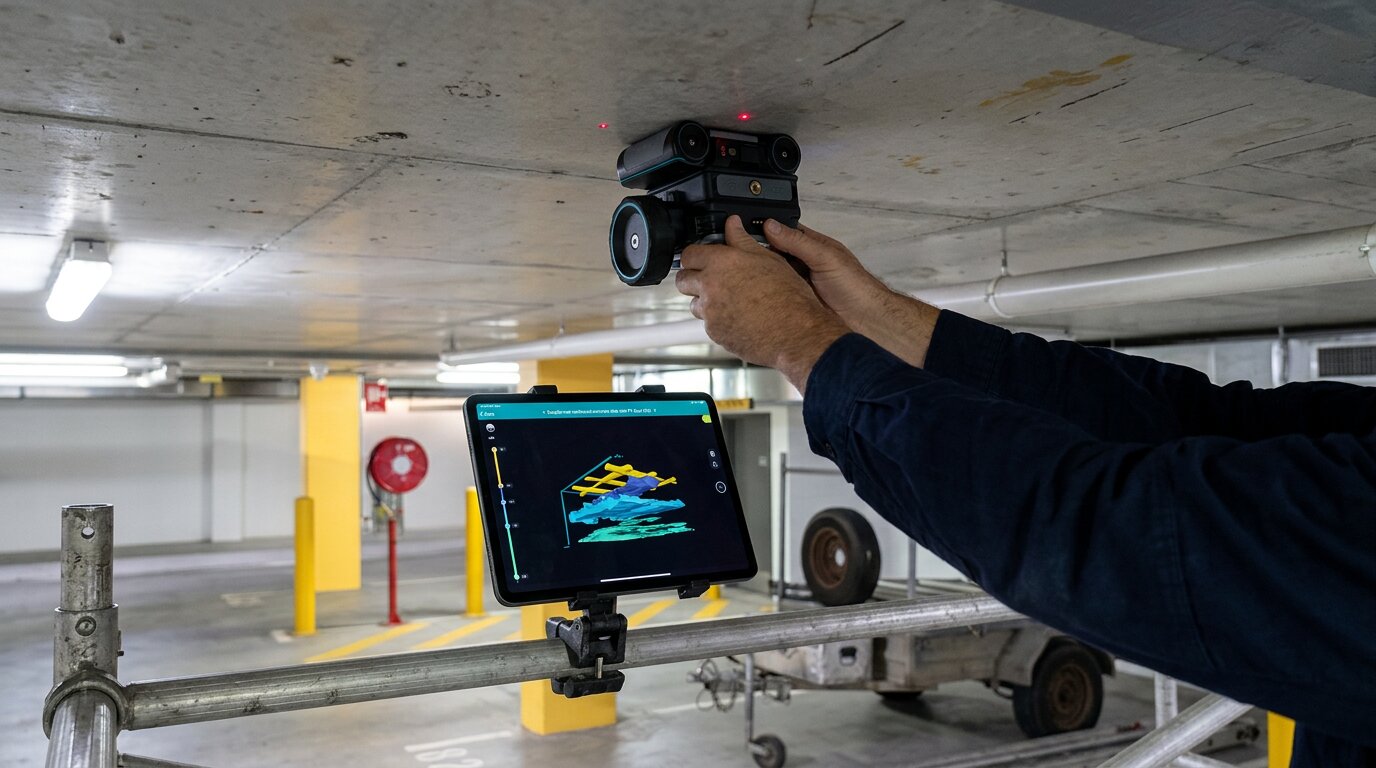
GPR Concrete Scanning, Concrete Radar & Slab Scanning
Concrete scanning, rebar mapping, and measured existing-condition documentation
GPR concrete scanning in Brisbane and Southeast Queensland for non-destructive concrete testing, concrete radar, rebar mapping, post-tension tendon location, slab scanning, conduit detection, void checks, and safe pre-core planning. SiteOps combines ground penetrating radar, Ferroscan, LiDAR, and targeted verification to produce existing-condition layouts for engineers, contractors, and asset owners.

UPV Testing
Assess concrete quality without destruction
Ultrasonic Pulse Velocity testing is a non-destructive method that measures the speed of ultrasonic pulses through concrete to evaluate its quality, uniformity, and integrity. Ultrasonic Pulse Velocity (UPV) testing for assessing concrete quality, uniformity, and detecting internal defects such as cracks, voids, and honeycombing.

Infrared Thermography
Detect hidden defects through thermal signatures
Infrared thermography is a non-contact inspection technique that captures thermal radiation emitted by building surfaces to detect hidden moisture, delamination, insulation gaps, and subsurface defects. Infrared thermal imaging for detecting moisture ingress, delamination, insulation deficiencies, and subsurface defects in concrete, masonry, and building envelopes.

Concrete Coring & Testing
Laboratory-grade analysis of structural materials
Concrete coring and testing is a destructive sampling method that extracts cylindrical specimens from structural elements for laboratory analysis of compressive strength, carbonation depth, chloride content, and material composition. Concrete core extraction, compressive strength testing, carbonation assessment, chloride profiling, and petrographic analysis through NATA-accredited laboratory partners.

Drone Inspection
Access the inaccessible safely
Drone inspection (UAV-based structural inspection) uses remotely piloted aircraft equipped with high-resolution optical and thermal cameras to assess facades, roofs, and infrastructure that are difficult or dangerous to access by traditional means. UAV-based visual and thermal inspection for structures, facades, roofs, and infrastructure where traditional access is difficult, dangerous, or cost-prohibitive.

Structural Monitoring
Continuous intelligence on structural behaviour
Structural monitoring is the continuous or periodic measurement of a building's structural behaviour using IoT sensors to track tilt, displacement, crack movement, strain, vibration, and settlement over time. IoT-based structural health monitoring using digital tiltmeters, crack gauges, strain gauges, and vibration sensors with real-time cloud dashboards and automated alerts.
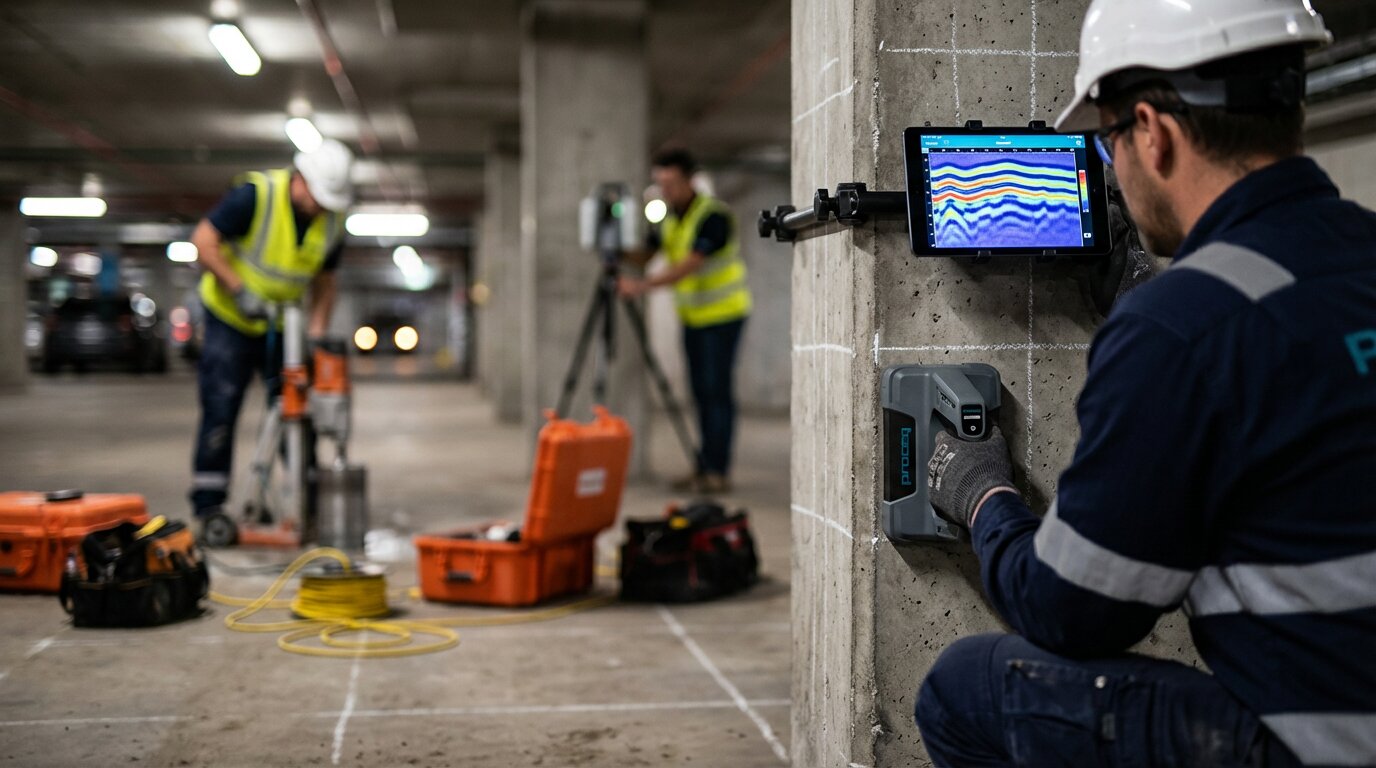
Comprehensive Investigation
Full-scope structural assessment programmes
A comprehensive structural investigation is a full-scope, multi-technology assessment programme that combines GPR, UPV, thermography, coring, and monitoring to answer complex structural questions about existing buildings and infrastructure. Multi-technology structural investigation programmes combining GPR, UPV, thermography, coring, and monitoring for complete structural assessment with RPEQ-certified reporting.

Heritage Building Assessment
Preserving the past with present-day technology
Heritage building assessment is a specialist non-destructive investigation approach designed to evaluate the structural condition of heritage-listed and historically significant structures while preserving original building fabric. Specialist non-destructive investigation for heritage-listed and historically significant structures, using non-invasive techniques to preserve original building fabric.
As-Built Detailing
Engineer-Ready Section Drawings
We turn GPR data into clear as-built sections - slabs, walls, columns and footings - with reinforcement layers, bar centres, cover and unscannable zones called out for your engineer.

Slab Section - Reinforcement Map
Long slab elevation with top and bottom layers, stirrups, cover dimensions, and bar spacing captured directly from GPR data.
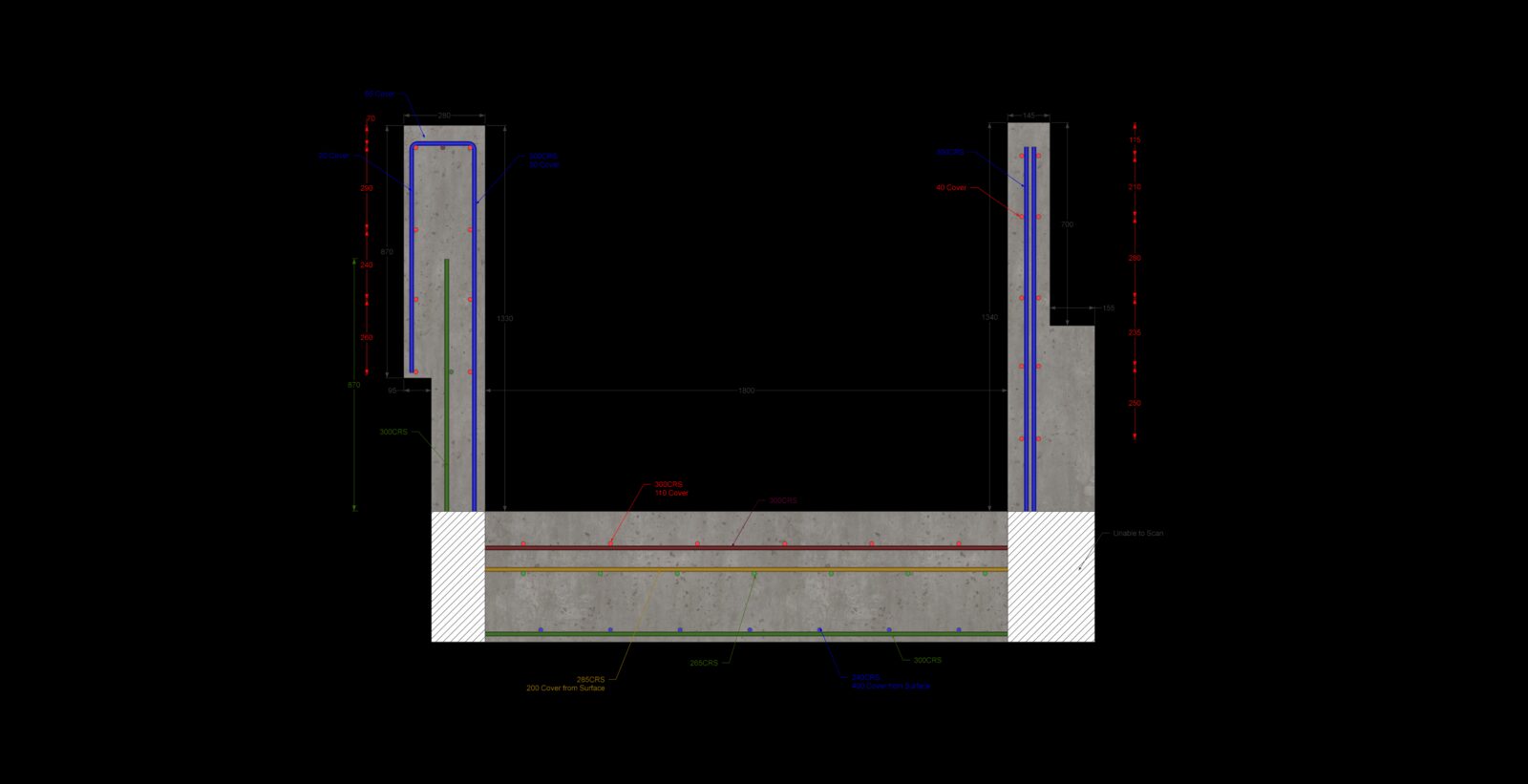
Wall & Footing Section - Cover & Cage
Wall and footing cross-section showing reinforcement cage, cover depth, bar centres, and unable-to-scan zones noted for the engineer.
NDT Technologies
Advanced Investigation Equipment
Non-Destructive Testing
Surface and sub-surface assessment without damaging the structure
Scanning & Imaging
Radar, laser and electromagnetic scanning for structural mapping
Sampling & Laboratory Analysis
Material extraction and NATA-certified laboratory testing
Structural Monitoring
Real-time and periodic measurement of structural behaviour
Computational Analysis
Advanced modelling and simulation of structural performance
Destructive & Proof Testing
Direct verification of structural capacity through controlled loading
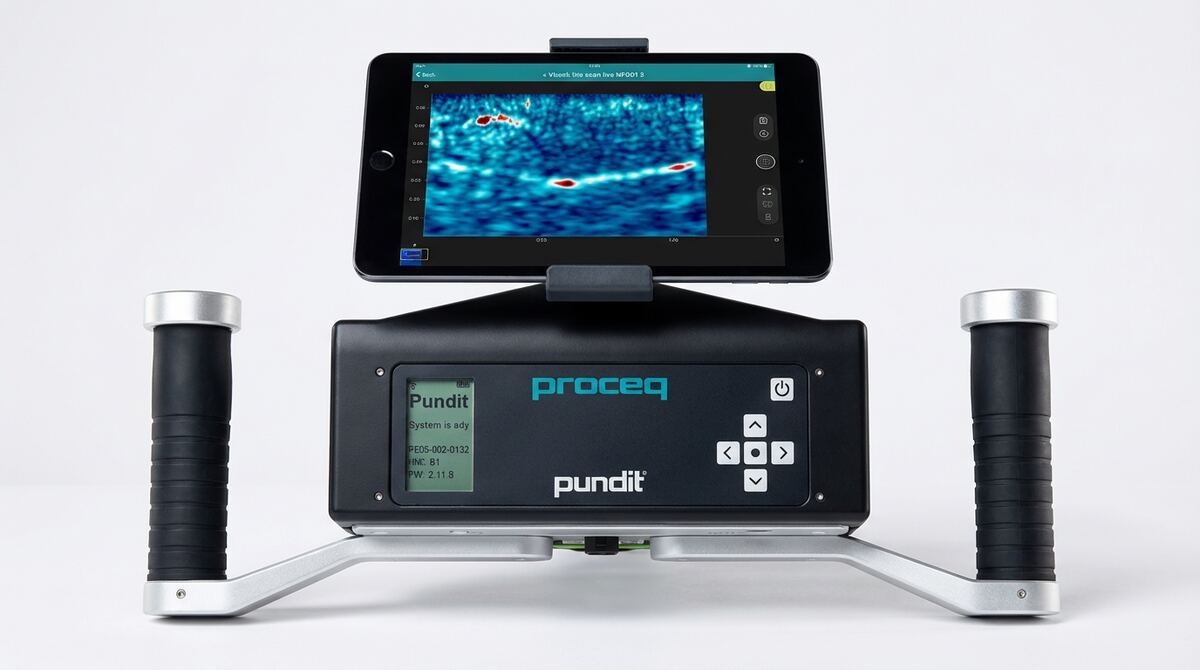
Proceq Pundit PD8000
Ultrasonic Imaging System
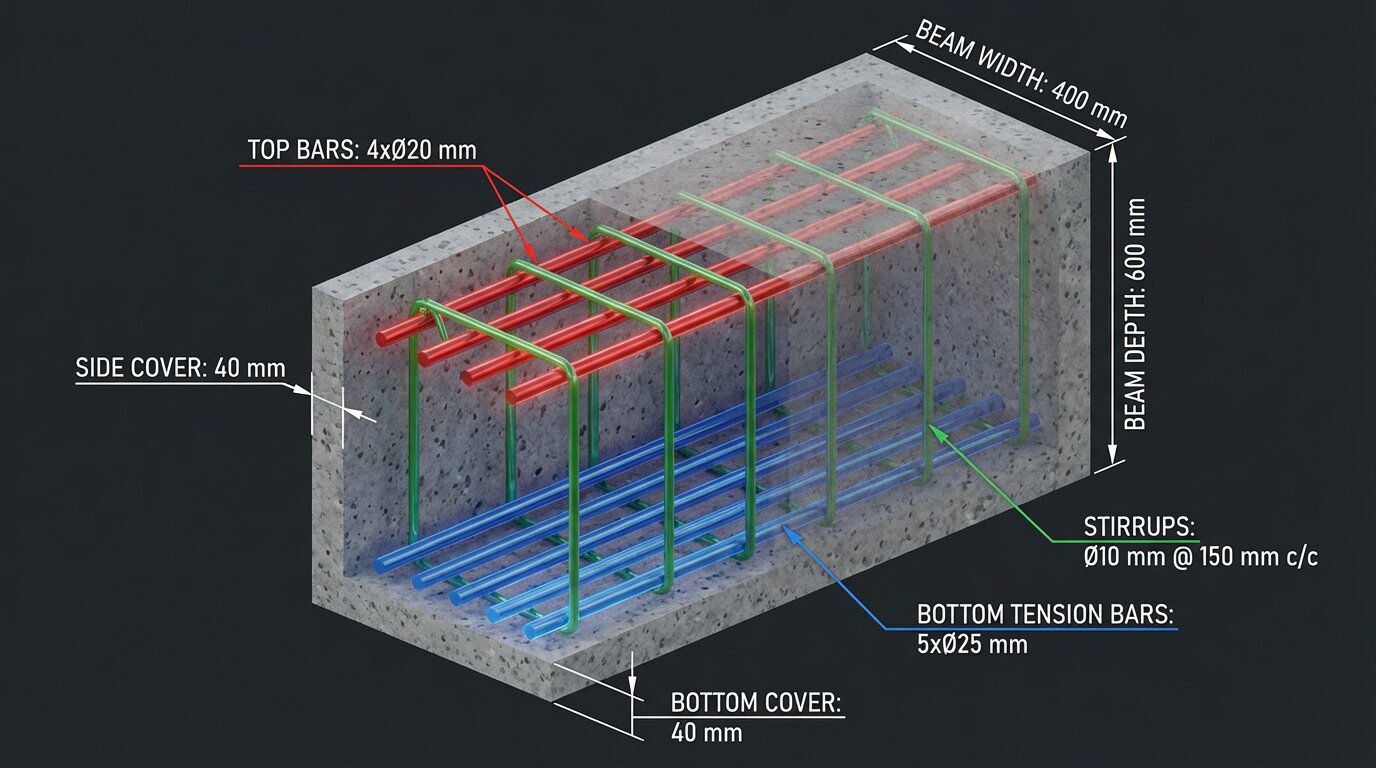
3D Reinforcement Models
As-Built Documentation
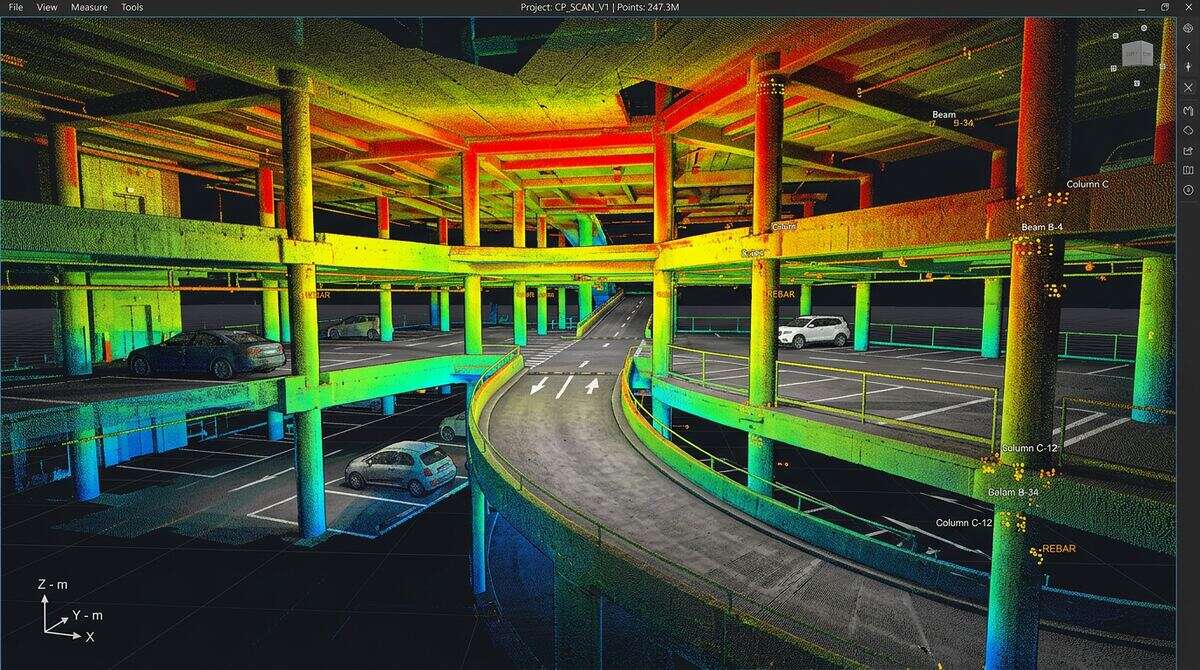
LiDAR Point Clouds
Digital Twin Capture
Case Studies
Recent Investigations
 Heritage
Queensland Art Gallery External Works
South Brisbane, QLD
Structural investigation of Queensland Art Gallery external works to establish concrete thickness, reinforcement placement, spacing, cover, and estimated bar diameters for engineering design and planning.
 Infrastructure
North Street Bridge Inspection
West Moreton (Toowoomba), QLD
Structural condition inspection of North Street Bridge including underside dilapidation assessment, crack mapping, exposed reinforcement logging, and PT tendon observations.
 Infrastructure
Hope Island Bridge As-Built Detailing
Helensvale, QLD
GPR-led investigation of Hope Island Bridge to establish as-built detailing of concrete balustrades, slab zones, and beam elements for design support.
Our Approach
Investigation Methodology
Scope & Brief
We assess your investigation requirements, review existing documentation, and define the optimal NDT methodology for your structure and objectives.
Field Investigation
Our technicians deploy GPR, UPV, thermography, and other NDT techniques on site. Non-invasive methods preserve building fabric while capturing comprehensive structural data.
Data Analysis
Our structural scientists process and interpret investigation data using advanced analysis software. We identify defects, assess severity, and map structural conditions digitally.
Technical Report
Detailed investigation report with findings, risk assessment, and remediation recommendations. Clear, actionable insights for asset owners and design engineers.
Sectors
Industries We Serve

Commercial & High-Rise
Office Towers, Retail Centres & Mixed-Use Developments

Heritage & Conservation
Heritage-Listed Buildings, Adaptive Reuse & Conservation Science

Infrastructure
Bridges, Tunnels, Marine Structures & Retaining Walls

Residential
Apartments, Multi-Unit Dwellings & Strata Buildings

Industrial
Warehouses, Factories, Plant Structures & Storage Facilities

Hospitality & Institutional
Hotels, Hospitals, Schools & Civic Buildings
Trusted by Engineers
Trusted Partners & Clients








ATA Certified
Anchor & Fixing Pull-Out Testing
All SiteOps anchor, bolt, and fixing pull-out tests are performed to AS/NZS 5532 and certified through Anchor Testing Australia - ensuring every result meets the load rating and compliance standards your engineer requires.
FAQ
Common Questions
What is non-destructive testing (NDT)?+
Non-destructive testing is a group of analysis techniques used to evaluate the properties and condition of materials, components, and structures without causing damage. In structural investigation, common NDT methods include ground penetrating radar (GPR), ultrasonic pulse velocity (UPV), infrared thermography, and electromagnetic cover metering. These methods provide data about what is inside a structure without cutting, drilling, or dismantling it.
How much does a structural investigation cost?+
Structural investigation costs depend on building size, the number of technologies required, access complexity, and reporting scope. A single-technology survey (e.g. GPR scanning one floor) typically starts from $1,500 to $3,500. A multi-technology programme for a commercial building ranges from $8,000 to $25,000+. SiteOps provides fixed-fee proposals after reviewing your brief and available documentation, so there are no surprises during the investigation.
Do I need a structural investigation before renovating?+
If your renovation involves cutting, coring, or penetrating concrete (for new services, structural modifications, or tenant fit-out), scanning before cutting is essential to avoid hitting reinforcement, post-tension cables, or embedded services. For change-of-use projects (e.g. office to retail, warehouse to residential), a structural investigation verifies whether the existing structure can support the new loads and occupancy.
What is the difference between GPR scanning and X-ray?+
GPR sends electromagnetic radio pulses into concrete and records reflections from internal features. It requires access to one side only, is safe for use in occupied buildings, and covers large areas quickly. X-ray uses ionising radiation and requires access to both sides plus an evacuation zone. GPR is the preferred method for 90%+ of scanning applications due to speed, safety, and cost. X-ray is reserved for critical post-tension cable identification where absolute certainty is required.
Do you provide concrete scanning in Brisbane?+
Yes. SiteOps provides GPR concrete scanning in Brisbane for slab scanning, rebar mapping, concrete radar, post-tension tendon location, void detection, and pre-core checks. Our Milton office supports same-week mobilisation for many Brisbane sites, subject to access and scope.
What is included in a structural investigation?+
A structural investigation may include document review, GPR scanning, UPV testing, thermography, concrete coring, chloride testing, LiDAR capture, structural monitoring, and RPEQ reporting. The final scope depends on the question being asked, such as hidden reinforcement, concrete condition, movement, corrosion risk, or change-of-use capacity.
How long does a structural investigation take?+
Single-technology site work (e.g. GPR scanning) typically takes 1 to 3 days. A multi-technology investigation takes 3 to 10 days on site depending on building size. Laboratory testing adds 7 to 14 business days. Report preparation requires 5 to 10 business days after lab results. A complete programme from brief to final report is typically 4 to 8 weeks. SiteOps offers expedited programmes for urgent matters.
Do you work outside Brisbane?+
Yes. SiteOps operates across Southeast Queensland including Brisbane, Gold Coast, Sunshine Coast, and Toowoomba. We also travel nationally for major projects, heritage investigations, and specialist assessment work. Our team mobilises equipment and personnel to your site location.
Structural Investigation Services in Brisbane
SiteOps is a specialist non-destructive structural investigation consultancy based in Brisbane, serving Southeast Queensland and project sites across Australia. We provide engineers, asset managers, and building owners with the hidden structural data they need before cutting, repairing, adapting, or monitoring existing buildings and infrastructure.
Our investigation programmes combine ground penetrating radar (GPR), concrete scanning, UPV testing, infrared thermography, concrete coring, LiDAR, and structural monitoring. Every scope is designed around the decision you need to make, not a generic checklist.
From pre-core slab scanning to post-fire damage assessment, from heritage building investigation to long-term structural monitoring surveys, SiteOps delivers evidence-based answers that reduce risk and cost for your project.
Start with structural investigation Brisbane, our structural monitoring survey Adelaide deployments, or concrete slab investigation and GPR scanning.
Why Engineers Choose SiteOps
- •RPEQ-certified investigation reports accepted by councils and certifiers
- •17+ NDT technologies deployed by qualified structural scientists
- •NATA-accredited laboratory partners for all destructive testing
- •Multi-technology programmes that cross-validate findings
- •Make Safe and Monitor hierarchy for proportionate recommendations
- •As-built documentation and CAD/BIM-ready deliverables
- •Same-week mobilisation for urgent investigations
- •Fixed-fee proposals with no hidden charges
Concrete scanning and structural investigation by location
Need a Structural Investigation?
Tell us about your structure and investigation objectives. Our structural scientists will recommend the optimal NDT approach for your project.