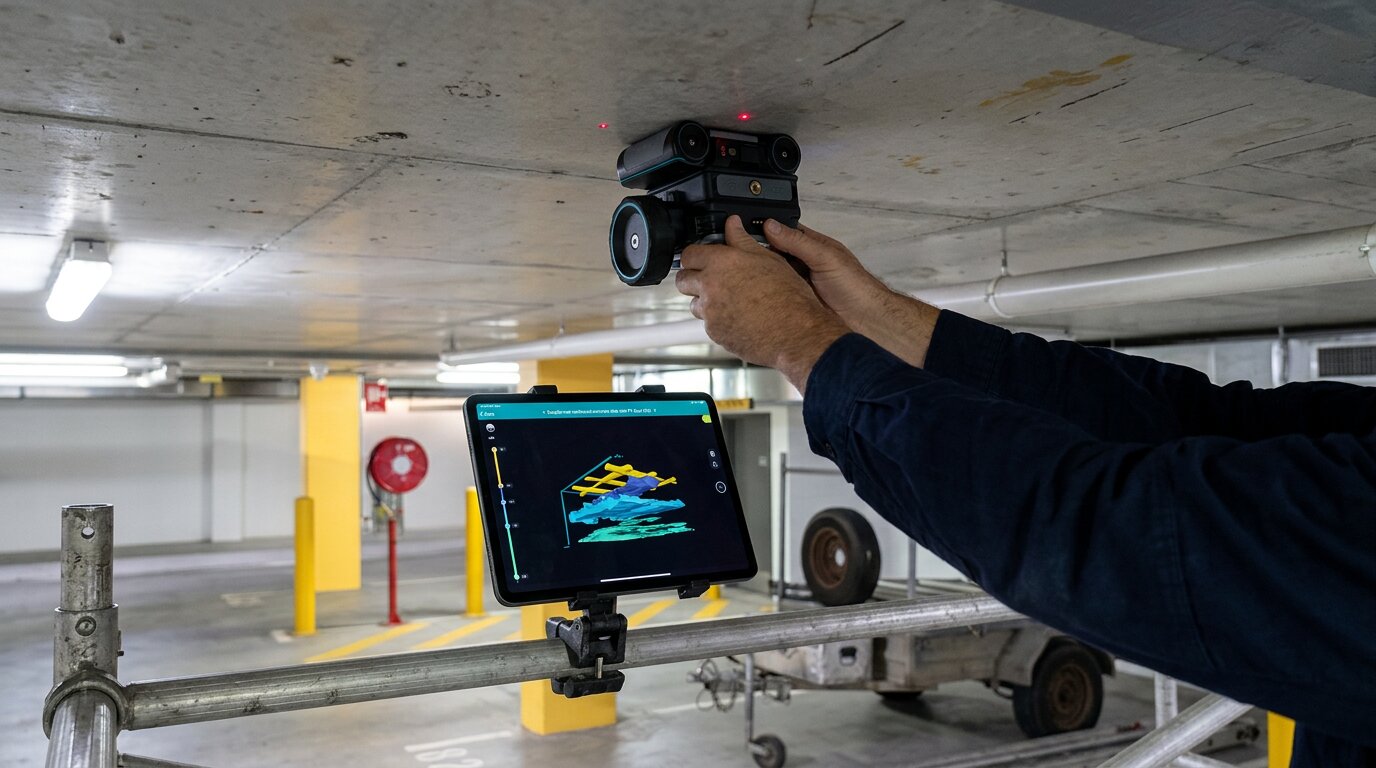
Concrete scanning, rebar mapping, and measured existing-condition documentation
GPR Concrete Scanning, Concrete Radar & Slab Scanning
SiteOps uses GPR concrete scanning to locate reinforcement, post-tension tendons, conduits, voids, slab thickness changes, and other hidden features before cutting, drilling, anchoring, or changing a structure. This gives project teams a measured site record instead of relying on old drawings or assumptions.
For searches like concrete radar Brisbane, concrete x-ray Gympie, slab scanning Gympie and concrete slab investigation, the practical service is the same: a controlled non-destructive concrete testing visit that maps what is hidden in the slab or wall and reports what can and cannot be confirmed from the accessible surface.
Our Brisbane team combines non-destructive subsurface mapping (GPR and Ferroscan), geometric capture (LiDAR and point cloud), and targeted visual checks to define slab zones, reinforcement risk areas, post-tension corridors, service routes, and penetration constraints before works begin.
Deliverables are made for practical project use: marked-up investigation plans, coordination overlays, pre-core clearance notes, and CAD/BIM-friendly as-built packages for architects, structural engineers, services consultants, and contractors.
Where scan confidence varies by area, SiteOps reports confidence zoning and recommended hold points. This helps teams stage works safely, avoid service or tendon strikes, reduce rework, and make faster decisions during fit-outs, refurbishment, and adaptive reuse projects.
Key Features
- •Brisbane concrete scanning for slabs, beams, columns, and walls
- •Rebar mapping with cover depth and spacing notes
- •Post-tension tendon location before coring, cutting, or anchoring
- •Embedded conduit and service conflict checks where detectable
- •Existing-condition capture checked against legacy drawings
- •Subsurface risk mapping for reinforcement and post-tension zones
- •2D plans and 3D coordination-ready as-built outputs
- •Confidence zoning with area-specific verification notes
- •Pre-cut and pre-core hold-point planning for site crews
- •Engineer-reviewed annotations for delivery teams
Standards
Applications
- •Concrete scanning before coring, drilling, and saw-cutting
- •Tenant fit-out penetration planning in post-tension slabs
- •Rebar mapping for structural engineering review
- •Embedded conduit and service conflict checks
- •Refurbishment and adaptive reuse coordination
- •Facade and services retrofit design
- •Pre-demolition scope validation
- •Heritage building measured documentation
- •Construction sequencing and hold-point definition
Codes & compliance
Australian Standards for GPR Concrete Scanning, Concrete Radar & Slab Scanning
Every gpr concrete scanning, concrete radar & slab scanning engagement is delivered against recognised Australian and international standards. These are the codes SiteOps works to, and how each one applies to the work.
ASTM D6432
Standard Guide for Using the Surface Ground Penetrating Radar Method for Subsurface Investigation
Governs how SiteOps plans antenna selection, line spacing, and data interpretation for GPR concrete scanning so reinforcement, conduits, and voids are mapped reliably.
ASTM D4748
Standard Test Method for Determining the Thickness of Bound Pavement Layers Using Short-Pulse Radar
Underpins slab and layer thickness estimation where SiteOps reports slab depth changes and bound layer geometry from GPR returns.
ASTM D6087
Standard Test Method for Evaluating Asphalt-Covered Concrete Bridge Decks Using Ground Penetrating Radar
Frames the approach to bridge deck and overlay scanning for delamination and deterioration mapping on infrastructure assets.
BS 1881-204
Testing Concrete. Recommendations on the Use of Electromagnetic Covermeters
Supports cover depth and rebar location work with Ferroscan covermeters, used alongside GPR to confirm reinforcement position and concrete cover.
AS 5100.5
Bridge Design, Part 5: Concrete
Provides the reinforcement detailing and cover context SiteOps uses when interpreting scan results on bridge and transport structures.
Stack & equipment
Technologies used

Case experience
Related projects
 Heritage
South Brisbane, QLD
Queensland Art Gallery External Works
Structural investigation of Queensland Art Gallery external works to establish concrete thickness, reinforcement placement, spacing, cover, and estimated bar diameters for engineering design and planning.
View project Infrastructure
Helensvale, QLD
Hope Island Bridge As-Built Detailing
GPR-led investigation of Hope Island Bridge to establish as-built detailing of concrete balustrades, slab zones, and beam elements for design support.
View project Industrial
Wacol, QLD
Wacol Warehouse Drainage Investigation
Structural investigation of the Wacol Warehouse drainage channel to identify subsurface voids and defects and quantify cracking and displacement behavior along the channel system.
View projectService areas
GPR Concrete Scanning, Concrete Radar & Slab Scanning by location
FAQ
Common questions about GPR Concrete Scanning, Concrete Radar & Slab Scanning
Is GPR the same as X-ray?+
No. GPR is not X-ray. Ground Penetrating Radar uses low-power electromagnetic radio waves and receives reflected signals to map subsurface features from one accessible surface. It does not use ionising radiation, does not require radiation exclusion zones, and is generally suitable for occupied environments. X-ray (radiography) is a different method that uses ionising radiation and stricter safety controls.
What does an as-built detailing package include?+
A standard package includes site capture methodology, marked-up plans, identified reinforcement and post-tension risk zones, mapped service corridors where detectable, confidence zoning, and recommended verification hold points. For projects requiring model-based coordination, SiteOps can also provide CAD/BIM-ready overlays and data extracts aligned to the project grid and level set-out.
Do I need GPR scanning before coring or cutting a concrete slab?+
Yes. If the slab may contain reinforcement, post-tension tendons, conduits, or embedded services, GPR scanning should be completed before any core, saw-cut, anchor, or penetration work. SiteOps marks likely risk zones and provides notes on scan confidence so the engineer and site team can choose safer penetration locations and decide where extra verification is needed.
Can SiteOps locate post-tension tendons in Brisbane buildings?+
Yes. SiteOps regularly scans post-tension slabs in Brisbane commercial, residential, and mixed-use buildings. GPR is used to identify likely tendon alignments, reinforcement zones, and slab features before fit-out works, anchor installation, or structural changes. Results are issued as practical markups and report notes for consultant and contractor review.
Do you provide concrete x-ray and slab scanning in Gympie?+
Yes, by scheduled deployment. SiteOps supports Gympie and northern Sunshine Coast projects where concrete x-ray alternatives, slab scanning, GPR, rebar mapping or pre-core checks are needed. We usually plan these visits with a defined test list so the mobilisation is efficient and the report answers the contractor or engineer question.
Can this be done when original drawings are missing or unreliable?+
Yes. As-built detailing is specifically designed for that situation. We establish a measured baseline directly from site conditions, then highlight discrepancies between observed conditions and any available legacy documentation. This allows design and construction teams to make decisions on current reality instead of assumptions.
How accurate is as-built detailing for live project decisions?+
Accuracy depends on access, element type, and capture method; accordingly, SiteOps reports confidence by zone rather than claiming a single blanket tolerance. High-confidence zones can be used for immediate coordination, while medium-confidence areas are flagged for controlled verification prior to irreversible works such as drilling, cutting, or fixing.
When should we engage as-built detailing in the project timeline?+
The highest value is early - during concept or developed design, before procurement and definitely before site cutting starts. Early as-built capture reduces redesign cycles, prevents latent-condition surprises, and allows contractors to plan methodology and sequencing with fewer variations during delivery.
Need GPR Concrete Scanning, Concrete Radar & Slab Scanning?
Tell us about your asset and objectives - we'll scope the right investigation programme.
Get a Quote