
Preserving the past with present-day technology
Heritage Building Assessment
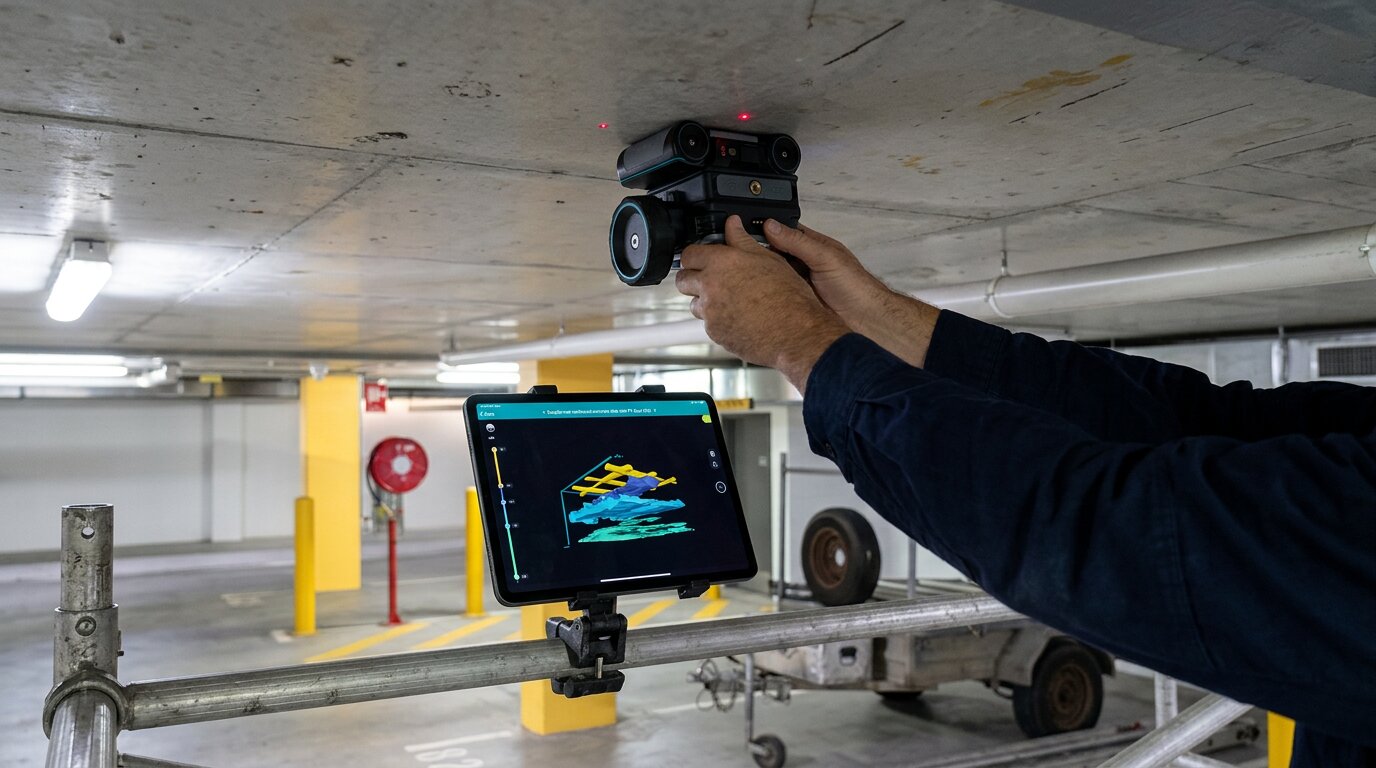
Heritage buildings require investigation approaches that preserve original fabric while delivering definitive technical data. SiteOps specialises in non-destructive investigation of heritage-listed structures - using GPR, LiDAR, and thermography to understand structures without invasive testing.
We work routinely without original drawings, assessing materials that have never been formally characterised - sandstone, limestone, lime mortar, wrought iron, early steel, and pre-standard reinforced concrete. Our approach starts with the presumption that original fabric is valuable and intervention should be minimal.
SiteOps provides heritage asset owners with a seamless journey from investigation through to remediation recommendations and long-term monitoring. 3D LiDAR scanning produces complete as-built documentation where none exists, providing the geometric basis for all subsequent technical analysis.
Heritage investigation demands particular expertise in interpreting construction systems, material behaviour, and deterioration mechanisms that differ fundamentally from modern construction. Lime mortar acts differently from cement mortar. Wrought iron corrodes differently from modern steel. Early concrete was mixed and placed differently from today. SiteOps brings this knowledge to every heritage investigation.
Heritage projects also carry an approvals dimension that ordinary investigations do not. For buildings on the Queensland Heritage Register, any work touching significant fabric needs approval before it happens, so SiteOps prepares a Heritage Investigation Method Statement that sets out exactly what will be done, where, and how the fabric will be protected and reinstated. We coordinate with heritage advisors and conservation architects so the investigation aligns with the building Conservation Management Plan and the Burra Charter principle of minimum intervention.
The output is designed to serve the whole heritage lifecycle. A 3D LiDAR scan becomes the permanent measured record of the asset, useful for conservation planning, adaptive reuse design, insurance, and disaster recovery. Material characterisation tells the engineer what they are actually working with so repairs use compatible, reversible materials rather than modern products that can accelerate decay. Long-term monitoring then protects the building through nearby development or as known movement is tracked over the seasons, giving custodians evidence-based confidence in how the structure is performing.
Key Features
- •Non-invasive investigation preserving original fabric
- •3D LiDAR scanning for as-built documentation
- •Heritage material sampling and identification
- •GPR scanning without original drawings
- •Heritage authority liaison and compliance
- •Conservation-compatible assessment and reporting
- •Mortar, stone, and timber analysis
- •Long-term structural monitoring for heritage assets
Standards
Applications
- •Queensland Heritage Register buildings
- •Adaptive reuse structural verification
- •Conservation management plan input
- •Heritage impact statement support
- •Pre-purchase heritage building assessment
- •Post-event heritage building evaluation
- •Heritage building long-term monitoring
- •Local heritage overlay properties
Codes & compliance
Australian Standards for Heritage Building Assessment
Every heritage building assessment engagement is delivered against recognised Australian and international standards. These are the codes SiteOps works to, and how each one applies to the work.
Queensland Heritage Act 1992
Queensland Heritage Act
The legislation governing work on State Heritage Register places, which sets the approval requirements SiteOps plans investigations around.
Burra Charter (ICOMOS)
The Australia ICOMOS Charter for Places of Cultural Significance
The conservation philosophy of minimum intervention and reversibility that shapes every non-destructive heritage assessment approach.
AS/NZS ISO 31000:2018
Risk Management - Guidelines
Provides the risk framework for proportionate recommendations that balance structural safety with fabric preservation.
AS 3600
Concrete Structures
Applied when assessing early and pre-standard reinforced concrete elements within heritage structures.
EN 1504 (Parts 1-10)
Products and Systems for the Protection and Repair of Concrete Structures
Guides selection of compatible repair and protection systems suited to historic concrete and masonry.
Stack & equipment
Technologies used
GPR
Ground-Penetrating Radar
Sub-Surface Structural Mapping Without Destructive Access

LiDAR
3D Laser Scanning & LiDAR
Point cloud survey, as-built documentation, and deformation analysis

UPV
Ultrasonic Pulse Velocity
In-Situ Concrete Quality and Uniformity Assessment

Ferroscan
Ferroscan
Electromagnetic Reinforcement Detection and Cover Depth Measurement

IRT
Infrared Thermography
Thermal Imaging for Subsurface Defect and Moisture Detection

Core
Core Extraction & Laboratory Testing
NATA-Certified Material Characterisation
Case experience
Related projects
 Heritage
South Brisbane, QLD
Queensland Art Gallery External Works
Structural investigation of Queensland Art Gallery external works to establish concrete thickness, reinforcement placement, spacing, cover, and estimated bar diameters for engineering design and planning.
View project Infrastructure
West Moreton (Toowoomba), QLD
North Street Bridge Inspection
Structural condition inspection of North Street Bridge including underside dilapidation assessment, crack mapping, exposed reinforcement logging, and PT tendon observations.
View projectService areas
Heritage Building Assessment by location
FAQ
Common questions about Heritage Building Assessment
Can investigation be done without damaging heritage fabric?+
Yes. The majority of our heritage investigation programme uses non-contact or surface-contact techniques - GPR, LiDAR, UPV, thermography, visual inspection - that cause zero damage to original fabric. Where destructive testing (coring, mortar sampling) is required, it is minimised to the absolute minimum needed for technical certainty. Core locations are selected at concealed positions, and all penetrations are repaired with conservation-compatible materials.
What if there are no original drawings?+
This is the norm for heritage buildings, not the exception. SiteOps uses 3D LiDAR scanning to produce complete as-built documentation - floor plans, sections, elevations - from the physical structure. GPR and Ferroscan mapping determine internal reinforcement layout. This measured data provides the foundation for all structural analysis and capacity assessment.
What heritage approvals are needed before investigation?+
For Queensland Heritage Register listed buildings, any work affecting heritage fabric requires approval from the Department of Environment, Science and Innovation. SiteOps prepares Heritage Investigation Method Statements and coordinates with heritage advisors to ensure investigation activities are approved before mobilisation. For locally listed properties, approval requirements vary by council.
How does heritage investigation differ from standard investigation?+
Heritage investigation prioritises fabric preservation over investigation efficiency. Standard investigation might take 15 cores - heritage investigation achieves the same technical certainty with 4–6 cores guided by comprehensive NDT screening. Material assessment accounts for lime mortar, sandstone, wrought iron, and early concrete behaviours that differ from modern materials. Reporting addresses heritage conservation requirements alongside structural science conclusions.
Need Heritage Building Assessment?
Tell us about your asset and objectives - we'll scope the right investigation programme.
Get a Quote