
Industrial structures operate under demanding loading conditions and often harsh environmental exposure. SiteOps investigates warehouse floors, factory columns, plant structures, silos, and storage facilities where structural adequacy directly affects operational safety and production continuity.
Key investigation drivers include increased loading from operational changes, structural deterioration from chemical or temperature exposure, fire damage assessment, and change of use structural verification. Our GPR scanning maps reinforcement layout for capacity assessment, UPV evaluates concrete quality, and drone inspection accesses elevated structures safely.
SiteOps designs investigation programmes that work within industrial operational schedules - investigating during shutdowns, weekend periods, or after hours to minimise production impact.
Typical challenges
- Investigating during limited shutdown windows
- Chemical and temperature exposure assessment
- Increased loading verification for operational changes
- Elevated structure access (silos, overhead cranes, plant)
- Floor slab capacity for heavy plant and storage
- Fire damage and post-event assessment
Capabilities
Related services
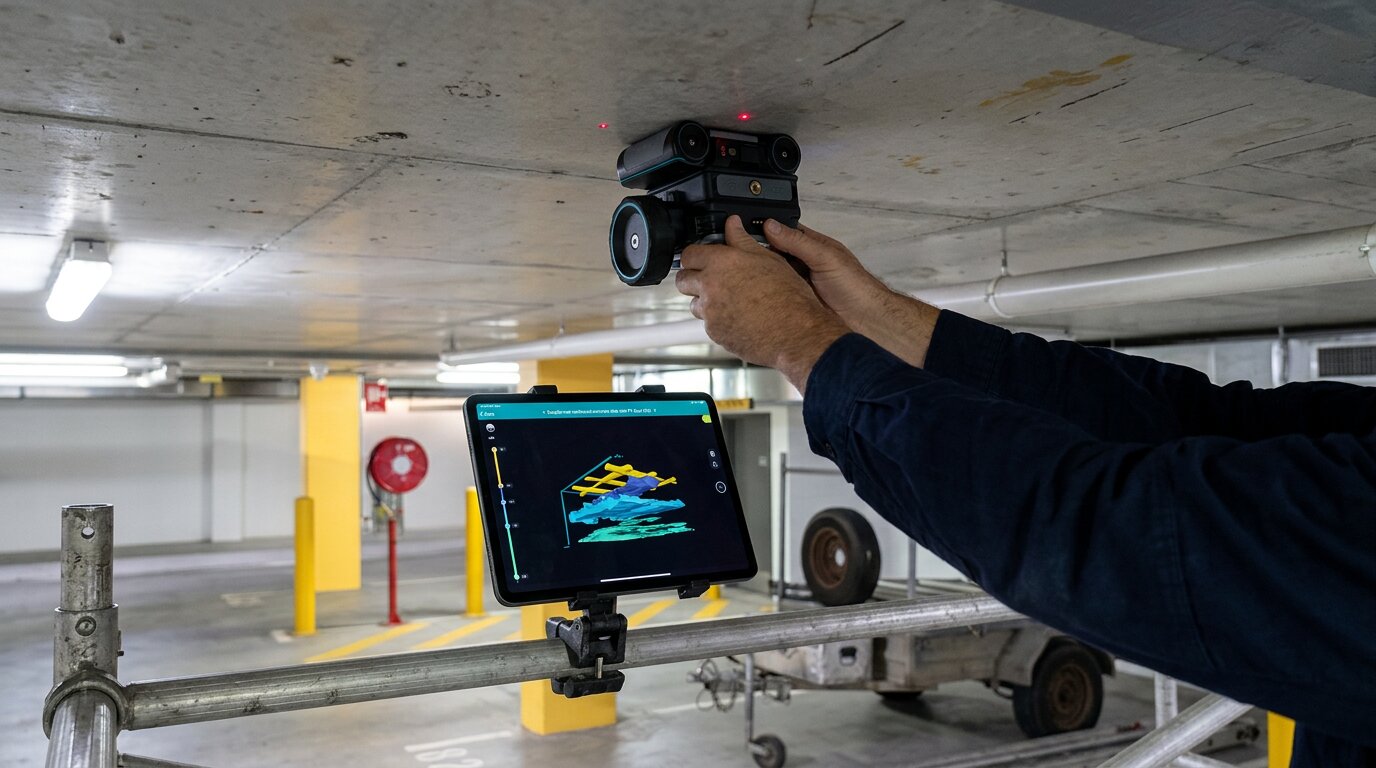
Concrete scanning, rebar mapping, and measured existing-condition documentation
GPR Concrete Scanning, Concrete Radar & Slab Scanning
GPR concrete scanning in Brisbane and Southeast Queensland for non-destructive concrete testing, concrete radar, rebar mapping, post-tension tendon location, slab scanning, conduit detection, void checks, and safe pre-core planning. SiteOps combines ground penetrating radar, Ferroscan, LiDAR, and targeted verification to produce existing-condition layouts for engineers, contractors, and asset owners.
View service →
Assess concrete quality without destruction
UPV Testing
Ultrasonic Pulse Velocity testing is a non-destructive method that measures the speed of ultrasonic pulses through concrete to evaluate its quality, uniformity, and integrity. Ultrasonic Pulse Velocity (UPV) testing for assessing concrete quality, uniformity, and detecting internal defects such as cracks, voids, and honeycombing.
View service →
Access the inaccessible safely
Drone Inspection
Drone inspection (UAV-based structural inspection) uses remotely piloted aircraft equipped with high-resolution optical and thermal cameras to assess facades, roofs, and infrastructure that are difficult or dangerous to access by traditional means. UAV-based visual and thermal inspection for structures, facades, roofs, and infrastructure where traditional access is difficult, dangerous, or cost-prohibitive.
View service →
Laboratory-grade analysis of structural materials
Concrete Coring & Testing
Concrete coring and testing is a destructive sampling method that extracts cylindrical specimens from structural elements for laboratory analysis of compressive strength, carbonation depth, chloride content, and material composition. Concrete core extraction, compressive strength testing, carbonation assessment, chloride profiling, and petrographic analysis through NATA-accredited laboratory partners.
View service →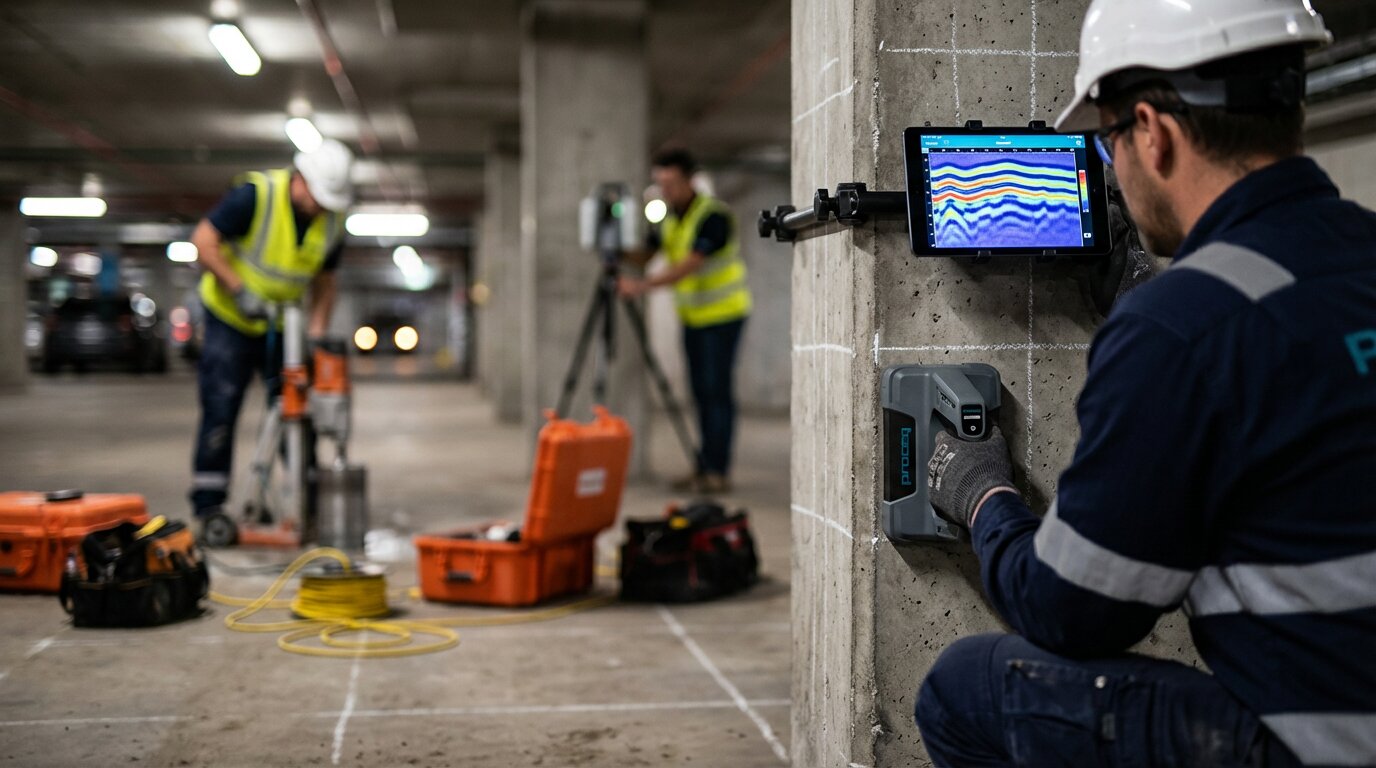
Full-scope structural assessment programmes
Comprehensive Investigation
A comprehensive structural investigation is a full-scope, multi-technology assessment programme that combines GPR, UPV, thermography, coring, and monitoring to answer complex structural questions about existing buildings and infrastructure. Multi-technology structural investigation programmes combining GPR, UPV, thermography, coring, and monitoring for complete structural assessment with RPEQ-certified reporting.
View service →Technologies
Technologies used in industrial
Plan an investigation for this sector
Our structural scientists scope NDT to your asset class, access constraints, and reporting requirements.
Get a Quote